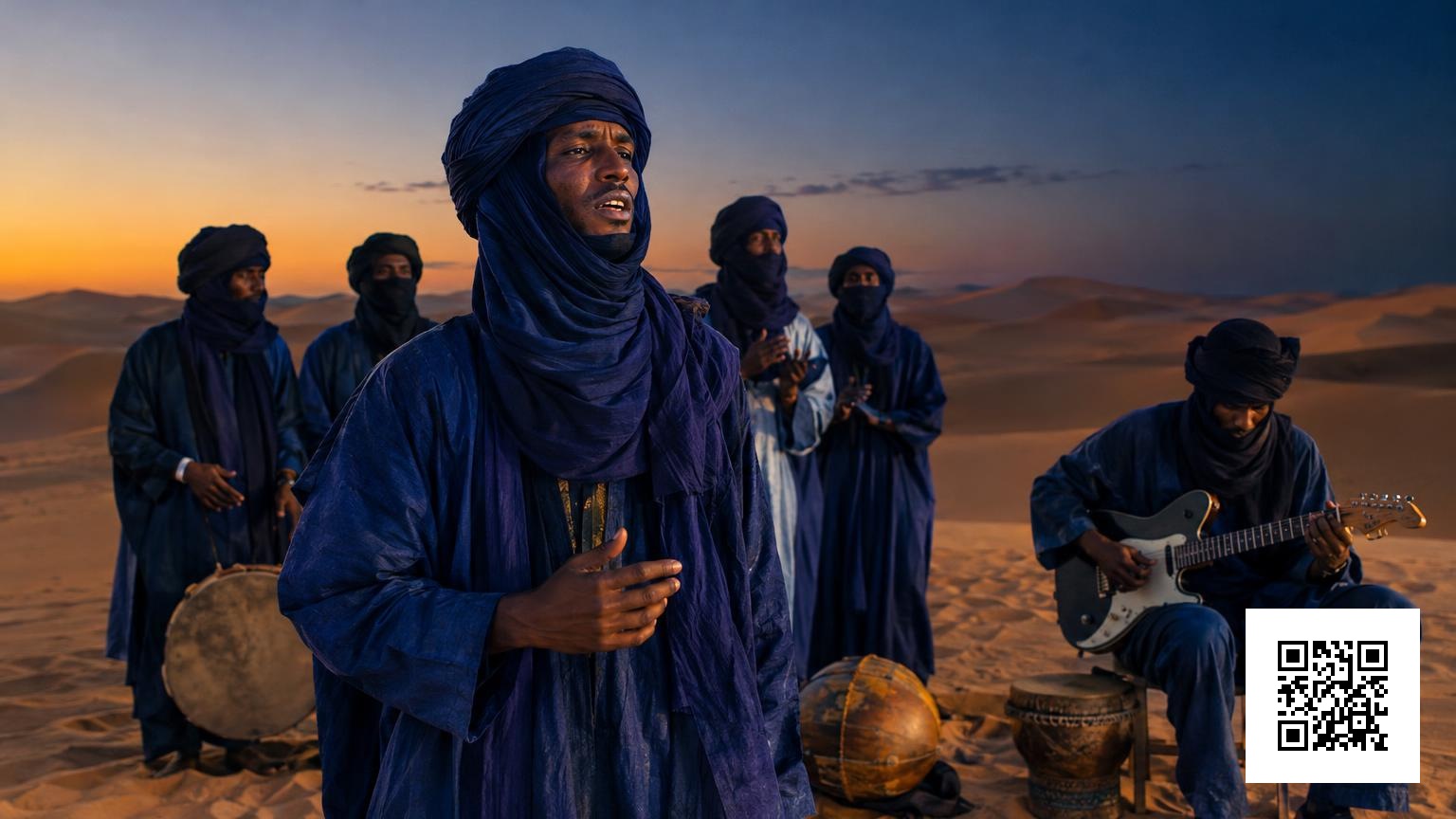
Ténéré Voices opens at 100 BPM with a single male line in Tamasheq that invites an answering chorus. The lead voice arrives alone, then the group replies in layered refrains that fold French and other Sahelian phrases into the same statement.
The recording is credited to AFRIKANA Sessions, Tamasheq Collective. From Tuareg communities across Mali and Niger the arrangement presents itself as a communal desert-blues hymn built around shared voice and repeating string figures.
Sahel as gathering space
This track treats the Sahel as a social room where voices meet. It names that geography in its title and then maps the music onto the idea of people answering one another across distance: a lead line, then many replies.
Because the credit is AFRIKANA Sessions, Tamasheq Collective, the recording emphasises ensemble voice rather than a single spotlight. You hear the dunes as an acoustic setting more than as a travelogue: proximity and shared phrasing are the composition’s organising ideas.
Language and communal address
Tamasheq holds the principal statements. Long, sung lines in Tamasheq form the song’s spine, while short refrains in French and Sahelian phrases widen the address and create public hooks listeners can join.
Those bilingual turns give the piece local specificity and regional reach. For a neighboring Tamasheq-centred approach, compare how another AFRIKANA feature treats similar lines in Azelik Rhythm: Tamasheq lines, French hooks and Sahelian winks.
Strings and intimate percussion
Pentatonic slide guitar frames the melody while a kora-inspired picking technique supplies repeating patterns beneath the voice. Guitar phrases return between sung passages as markers rather than long solos.
Percussion remains close-miked and small: calabash and frame instruments keep a steady, near-field pulse. That immediacy makes the chorus sound like neighbours answering one another, an effect I like to call « Le goût de ça ».
Tempo, use and audience
At 100 BPM the track holds a walking pace that leaves room for extended lines and for chorus replies to land. The tempo keeps the piece measured rather than rushed and allows phrases to breathe until they become collective statements.
The arrangement suits gatherings, remembrance and public prayer across the Sahel thanks to its bilingual hooks and communal layout. If you want to compare pace across Sahel recordings, listen to Wind Over the Dune's 64 BPM Desert Pulse. For curated paths through similar songs try Toutes les playlists or take the music on mobile with L'application AFRIKANA.
Desert Blues / Tishoumaren (Assouf)
Ténéré Voices sits inside Desert Blues, also known as Tishoumaren or Assouf, a Sahelian style that places extended vocal lines and repetitive string phrasing at its centre. This track foregrounds communal singing and pentatonic melodic language.
Origins and development
Tishoumaren and Assouf arise from Tuareg vocal practice and nomadic song forms across Sahara and Sahel routes. Over decades those long vocal turns combined with repeating string motifs to form what is commonly identified as Desert Blues; Ténéré Voices continues in that line by privileging extended Tamasheq statements and cyclical guitar figures.
Defining traits
This recording names several explicit traits: a steady 100 BPM pulse, pentatonic slide guitar motifs, a kora-inspired picking technique and layered choral replies in Tamasheq, French and other Sahelian phrases. Vocals favour long lead lines answered by a strong chorus, and percussion is kept near and intimate to preserve a communal sound.
How this track fits
Ténéré Voices emphasizes the meditative, communal side of Assouf rather than instrumental display. Call-and-response is the engine: chorus replies carry weight equal to the lead, and the repeating string figures act as an organising scaffold for each cycle.
Styles to explore next
To continue, listen to other Desert Blues and Sahelian hymns that foreground long Tamasheq lines and shared refrains. AFRIKANA’s coverage guides that route across playlists and articles on Heart of Africa : tous les articles (/heart-of-africa/).