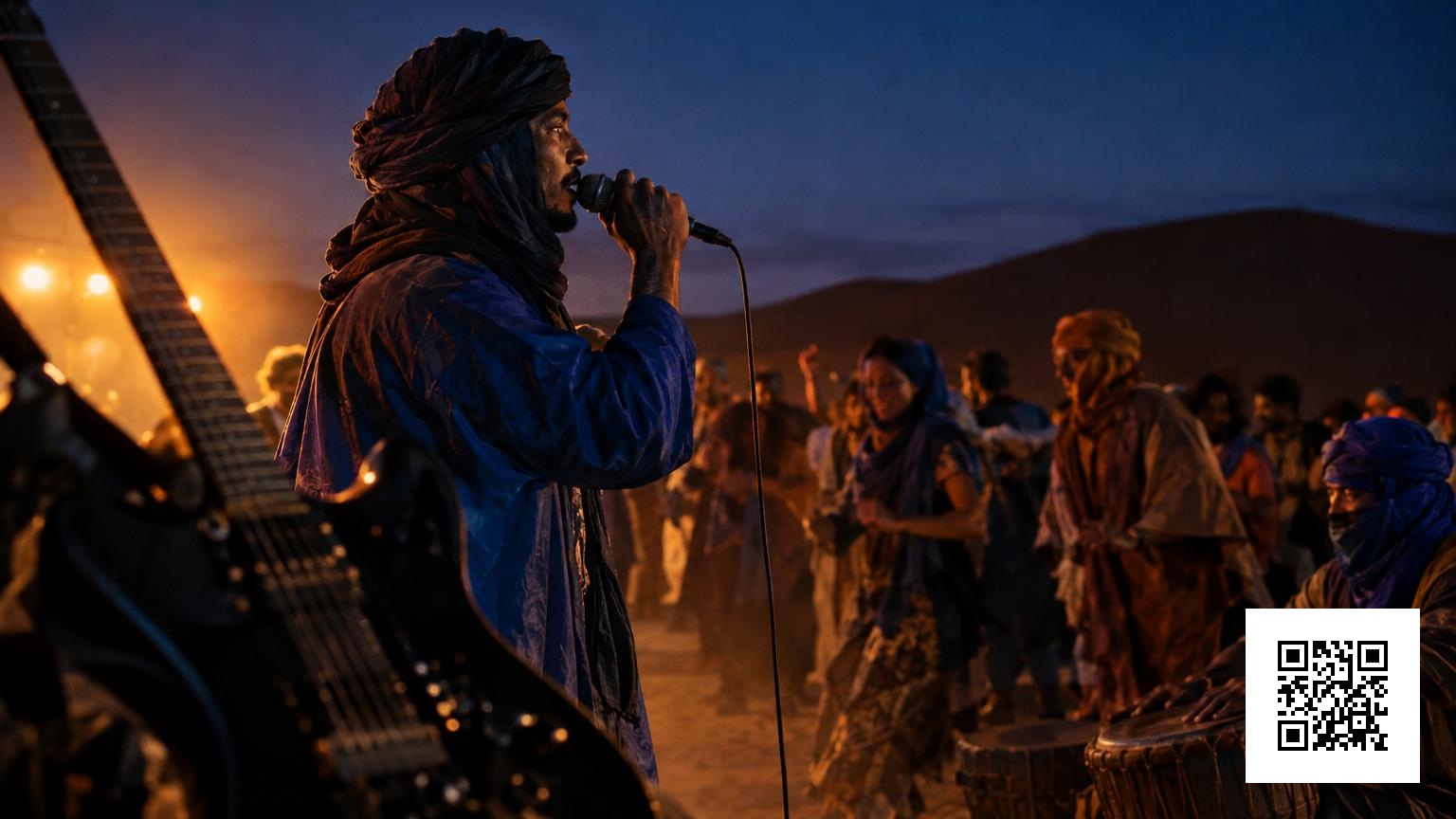
Azelik Rhythm runs at 132 BPM and puts long vocal lines in Tamasheq at the centre of its desert dance. Those extended Tamasheq turns anchor the call-and-response and shape how the guitar and percussion move through each section.
Short refrains in French return regularly between those Tamasheq passages, while brief inserts labelled langues sahéliennes act like local punctuation. Together these three layers organise attention: who the music speaks to first, and who it invites in from the wider francophone and Sahelian world.
Tamasheq as the organising voice
Lead vocal lines arrive in Tamasheq and are given space to unfold. Long phrases dominate the track’s forward movement and sit front in the mix, so the dance follows their cadence rather than the other way around.
That placement makes Tamasheq the intimate conversation of the recording. It addresses people who carry the language and its references, and it holds the song’s Assouf identity at every turn.
When Tamasheq leads, the rest of the arrangement responds. Pentatonic guitar figures and kora-guitar textures answer or reinforce the vocal arcs, but the language remains the organising pulse that orders the call-and-response.
French refrains as quick public hooks
Between longer Tamasheq turns the song uses short refrains in French that repeat and return. These refrains act like a chorus a wider francophone room can catch on to fast.
Placed as compact hooks, French lines create a shared point for listeners in clubs or on radio. They do not displace the Tamasheq centre, but they make the track easier to join in the middle of a set.
That recurrent French anchor also frames the song for francophone playlists and dancefloors, where a single repeated phrase helps the audience lock onto the groove. For related listening, see Wind Over the Dune's 64 BPM Desert Pulse.
Langues sahéliennes as regional signals
Short inserts described as langues sahéliennes appear as quick calls between the main lines. They are brief and function like local winks thrown into the arrangement.
These touches mark neighbouring communities and add regional colour without taking over the song. « Le goût de ça » (the taste of that) is audible in these small gestures: they register belonging and a nearby reference in a single phrase.
Because they are compact, those Sahelian phrases work especially well in performance. They call out to adjacent audiences and help fold multiple communities into the same dance floor with a minimum of words.
How the layout maps audiences
Read together, the vocal design sorts listeners into concentric circles. Tamasheq forms the inward circle, French provides a wider public edge, and langues sahéliennes stitch neighbouring groups into the same room.
This ordering lets the track remain rooted in Mali and Tuareg traditions while moving toward club contexts and francophone radio. The balance steers attention rather than flattening difference.
If you want to explore how similar language choices work across desert grooves and club directions, try Afropop & Amapiano, African Music Radio… or browse more on Heart of Africa : tous les articles.
Desert Blues (Tishoumaren / Assouf)
Azelik Rhythm sits in Desert Blues, named Tishoumaren or Assouf, a Sahelian strand where pentatonic guitar figures and trance-ready grooves meet. On this recording those features move at a club-ready 132 BPM and shape both voice and dance.
Origins and development
Desert Blues grew from Tuareg and Sahel traditions across Mali and the Sahara. Communal singing and dune-side gatherings translated into electric textures and extended call-and-response, and the style has long blended local forms with amplified string figures.
Defining traits
On this track the tempo is 132 BPM, melodies rest on pentatonic guitar riffs and kora-guitar textures, and hand percussion and calabash keep the drive steady. Vocals are primarily in Tamasheq, with recurring French refrains and brief langues sahéliennes inserts arranged as call-and-response.
How Azelik Rhythm fits
Azelik Rhythm keeps the desert voice and pentatonic lines but pushes them into a faster, dance-oriented frame. The language layout preserves local anchors while easing entry for francophone audiences and adjacent Sahelian communities.
Styles to explore next
If you want to stay close to the dunes, listen to other Assouf or Desert Blues titles. If the track’s dance direction interests you, follow its energy toward upbeat Sahelian grooves and club playlists on the AFRIKANA app; Discover AFRIKANA, stream African radio & songs on mobile.