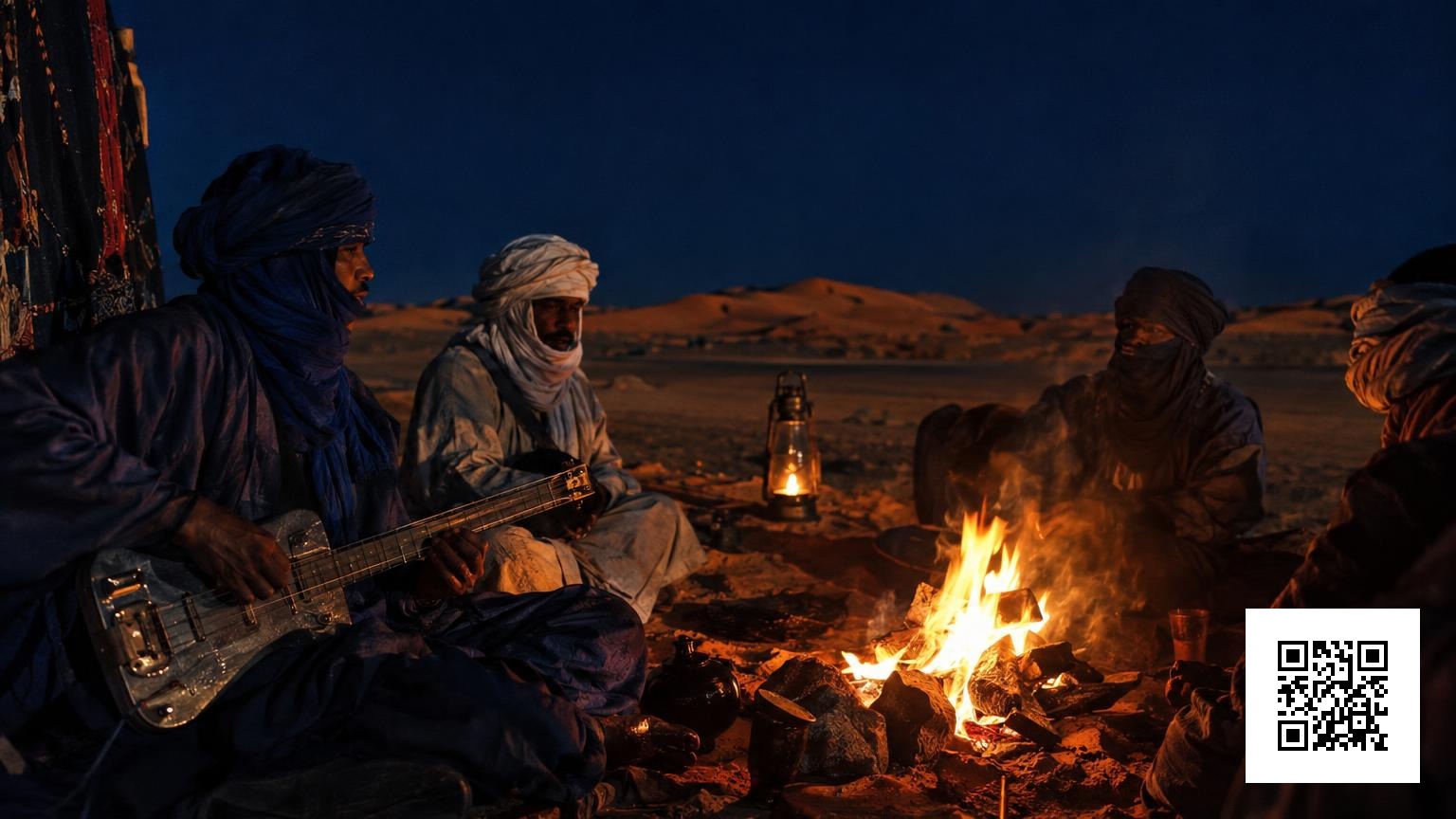
Sands of the Route opens with a Tamasheq lead that calls into the night and leaves room for French and other Sahelian phrases to answer. The song runs at 92 BPM, a measured caravan pace that spaces each exchange so every voice can be heard.
Language is the organising instrument here: Tamasheq carries the single-line statements, while French and regional replies fold those lines into a chorus that maps several communities onto one road. That arrangement directs attention at once inward, toward shared memory, and outward, toward listeners beyond a single camp.
Tamasheq as the opening speaker
The lead vocal arrives in Tamasheq and sits forward. Phrasing behaves like a speaker at the front of a caravan, a solitary line that asks or names, then pauses for the desert to answer.
Using Tamasheq as the primary voice anchors the song in Tuareg-speaking Sahel regions. It gives the piece an internal address: people who share place and history hear a line first and recognise its references in the phrasing and cadence.
For other Sahel pieces that foreground Tamasheq lines, see Ténéré Voices, a Sahel hymn in Tamasheq.
French woven into the replies
French appears in the answering phrases rather than replacing the lead. Those refrains sit beside Tamasheq and act as a public register that can be heard across towns and crossroads.
Because French answers rather than leads, the song keeps its Sahelian centre while opening a speaking space to listeners for whom French is a common public tongue. That position makes statements audible beyond a single nomadic circuit.
A close reading of how French can function as a public narrator appears in French anchors Pas à pas while Wolof and Pulaar answer.
A chorus of Sahelian languages
Beyond Tamasheq and French, the responses fold in other Sahelian phrases. The chorus becomes layered texture: quick regional replies, short refrains and overlapping syllables that make the group voice feel like a roadside gathering.
That multiplicity maps several communities onto the same route. Listeners who travel between Mali and Niger border regions, or who hear these lines on local radio, encounter a chorus that contains familiar fragments from multiple speech communities.
If you want tracks that mix Tamasheq leads with varied replies, compare this arrangement with Assouf of the Dunes, a 92 BPM Tamasheq Desert Blues.
Who the language choice calls in
The song addresses two listening positions at once. The Tamasheq opening speaks first to those who recognise the idiom immediately; French and regional refrains invite a wider Sahel audience to join the conversation.
Le goût de ça, the taste of that, is audible here as recognition for those who hear Tamasheq first. At the same time, French offers a bridge for listeners who meet the song at a distance or on African radio.
For a late-night sequence that places Desert Blues alongside other continental sounds, see the African Night Drive listening guide.
Desert Blues (Tishoumaren / Assouf)
This track sits in Desert Blues, known as Tishoumaren or Assouf, a Sahel style marked by steady midtempo pulses and repeating pentatonic slide phrases. On Afrikana Best Sounds it joins other regional strands such as Algerian Raï in cross-Sahel programming.
Where the style comes from
Desert Blues grew from Tuareg musical practices across the Sahel and from exchanges between nomadic life and urban circuits. The style travels with people who move between Mali and Niger border regions and beyond into Algeria.
Defining traits
A typical organising pulse for this style is a measured midtempo; Sands of the Route runs at 92 BPM. Repeated pentatonic slide guitar phrases and call-and-response vocals are central. The song names textures such as a kora-inspired guitar feel, sparse bass, calabash and hand percussion, plus warm reverb that suggests wind and horizon.
How Sands of the Route fits
This piece follows the Assouf pattern: a steady caravan pulse, lead Tamasheq lines and responding French and regional phrases. Language here is not decoration; it is the map that tells who is being addressed and where the listening bodies are placed along the road.
Neighbouring styles to explore
Listen next to other Desert Blues pieces and to Algerian Raï strands that share cross-Sahel circulation. AFRIKANA Best Sounds collects these registers so listeners can hear how tempo and language organise address across neighbouring traditions.