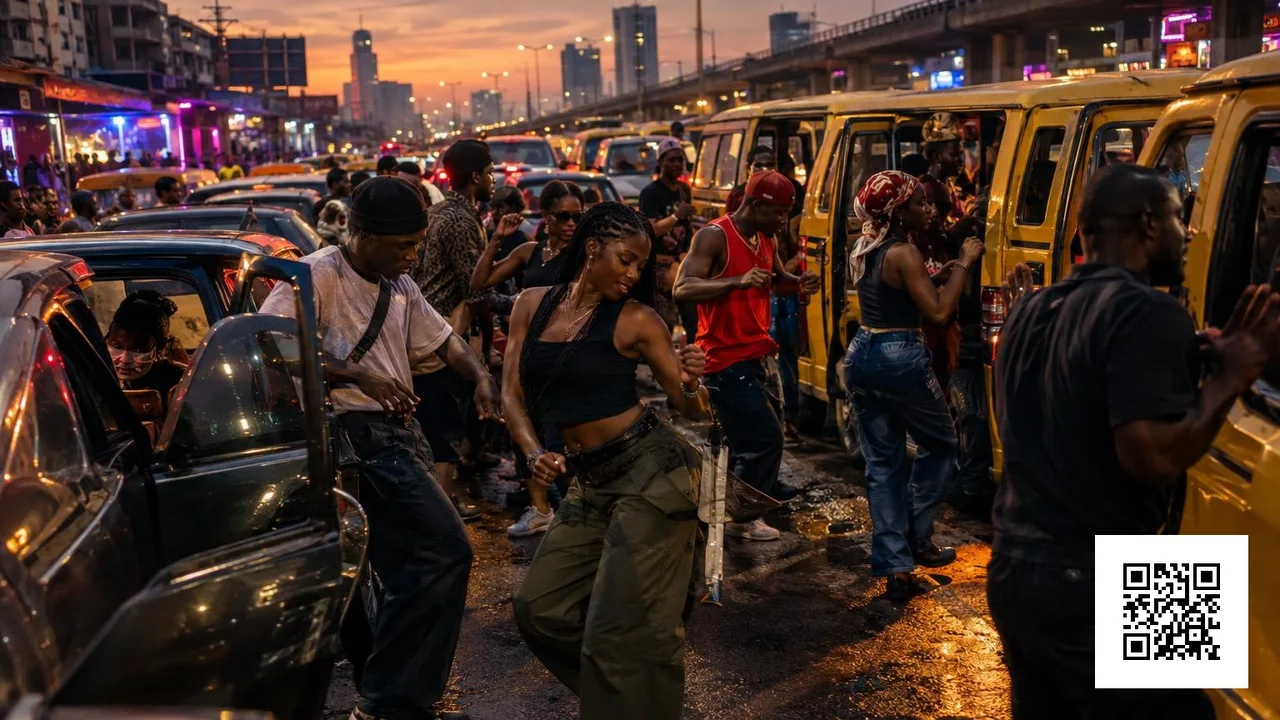
We never reach speaks in Nigerian Pidgin and it makes that choice the track's engine. Short, clipped lines in Pidgin sit beside danfo horn motifs, coins, car doors and steering-wheel hits from the first bar, so voice and street noises trade quick answers.
The piece runs at 130 BPM and lists moods that read explosive, funny, urban, euphoric, young and addictive. Its description frames Lagos traffic as a source: danfo horns, coins, doors and steering-wheel hits are treated as real instruments, and that framing explains why compact Pidgin lines land like shouts in a crowded bus.
Nigerian Pidgin as the public line
Phrases arrive short and repeatable. Each Pidgin turn behaves like a tag you can pick up on the street or in a car. The voice stays mostly in a narrow register so it can be heard beside bright horn motifs and quick metallic taps.
That economy of words keeps the line immediate. Instead of long sung sentences, the track offers quick statements that become recognisable almost instantly. Le goût de ça (the taste of that) is the instant you recognise a Pidgin tag and clap or sing it back.
This layout turns language into choreography. A single Pidgin turn can function as a cue: it signals laughter, complaint or invitation, and the crowd or passenger understands which one because the words are compact and repeated.
Street noises turned into musical replies
Danfo horn motifs puncture the top of the mix while coins, door taps and steering-wheel hits fill the smaller rhythmic gaps. Those objects are used as audible material, not background colour: they answer vocal lines and create mini-melodies you recognise from the commute.
Because the found sounds are short, they match the brief Pidgin turns. A horn stab can land just before a vocal tag, or a coin tap can echo a word’s last consonant. The effect is conversational: the city speaks back in the same pace as the singer.
Humour is a built-in result. Ordinary annoyances become gestures you laugh with. That transformation, audible and literal, is where the track's funny and explosive tags come from.
130 BPM keeps motion inside the delay
The tempo is 130 BPM. At that speed the groove refuses being still: even when lyrics describe a hold-up, the music moves forward. Short Pidgin exclamations land as rhythmic punctuation against a steady forward pulse.
Top-line horn motifs and clipped metallic taps repeat with insistence at this pace, which turns recognisable street fragments into hooks. The track’s low register, labelled Street Bass in the style name, holds the forward shove while the city gestures sit on top.
That tension between spoken delay and moving beat makes the song feel like a pre-party that has already begun before arrival.
Who hears this and where it sits
We never reach speaks first to listeners who read Lagos sounds as shared signals: if you hear a danfo horn and think both annoyance and invitation, the song lands differently. It rewards recognition and a local sense of humour.
Practically, the track suits moments that are club-adjacent or car-ready, places where the party starts while you're still en route. For mixes that sit near this energy try Afropop & Amapiano, African Music Radio or curated urban grooves on Toutes les playlists.
Read across similar pieces at Má sún mọ́ mi in the Yoruba Afrohouse pulse and discover more editorial writing at Heart of Africa : tous les articles. Also, Discover AFRIKANA, stream African radio & songs on mobile via L'application AFRIKANA.
Lagos Danfo Afrohouse × Horn Synth × Street Bass
The style name maps a street-to-club route: an Afrohouse pulse shaded by horn timbres and a low street register. It treats city noise as melodic and rhythmic material and places concise vocals at the centre.
Where the style comes from
The danfo reference signals public-bus soundscapes: horn motifs familiar from Lagos routes become melodic hooks. Naming those bus timbres anchors an urban reading of house-derived dance forms that borrows directly from city traffic.
Defining traits
Tempo is explicit here: 130 BPM for this track. Top-line gestures come from horn motifs and short metallic taps; a low Street Bass register keeps the track grounded while vocals in Nigerian Pidgin deliver compact, repeatable lines.
Mood tags attached to the style and this song, explosive, funny, urban, euphoric, young, addictive, describe how clipped horn calls, quick taps and a steady low end create moments designed to be recognised and repeated.
How We never reach fits the label
We never reach follows the blueprint by treating traffic sounds as instruments and locking tempo. Found sounds remain audible and repetitive so the paradox, being stuck while the party is already on, stays audible in the arrangement.
The compact Pidgin voice shares space with horn stabs and metallic hits rather than dominating them, which keeps the performance feeling present rather than removed from the street.
Styles to explore next
If this track hooks you, try longplays and mixes that gather urban club sounds like Afropop & Amapiano, African Music Radio or browse city-ready playlists on Toutes les playlists.
For editorial context on short vocal lines and street timbres across scenes, see other Heart of Africa pieces and playlist write-ups that trace how city gestures travel between radio and club.