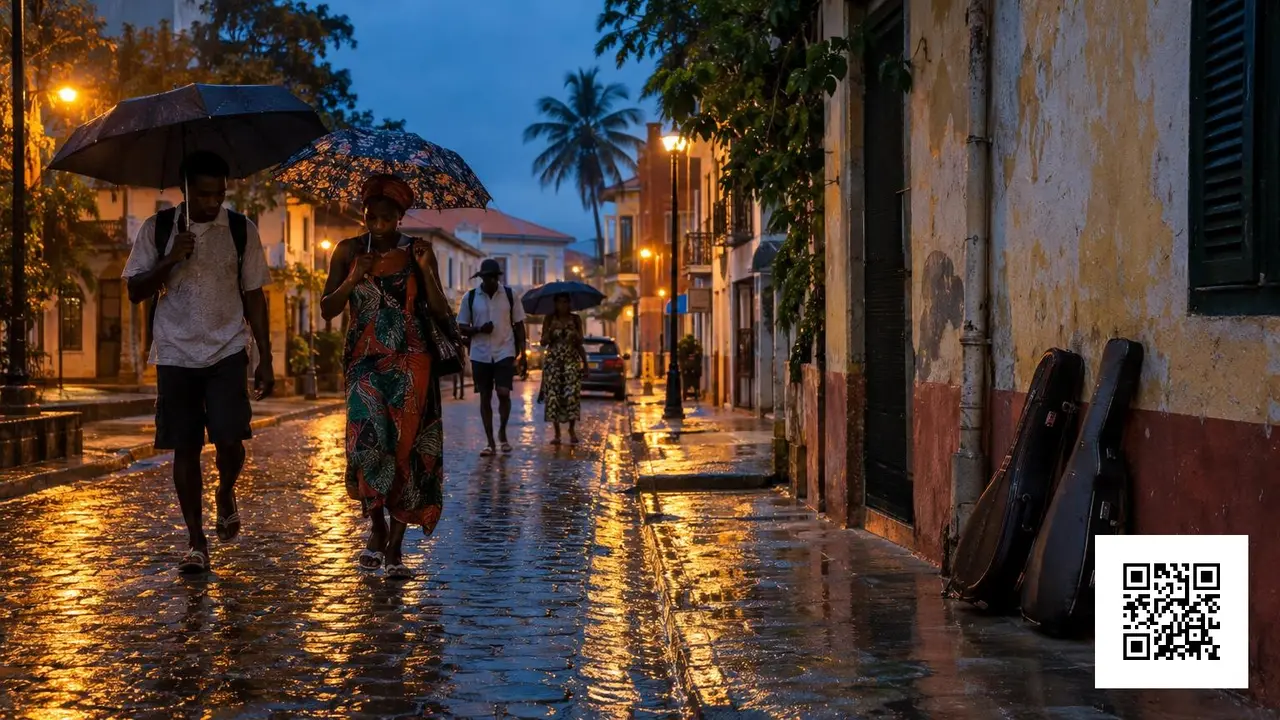
Bissau Depois da Chuva begins with a clear organising number: 102 beats per minute. That steady midtempo sets a walking pace that carries every arrival and hold in the arrangement.
The song names its theme: Après un gros orage, la ville retrouve son rythme. The style is Gumbe moderne × Afropop acoustique × groove afro-latin organique and the languages are Crioulo da Guiné-Bissau and Portuguese. I will follow the music in the order you hear it: pulse, textures, voices, arrangement, then the cultural shape the track sketches.
A 102 BPM walking pocket
At 102 BPM the pulse is measured and breathable. It is neither urgent nor slow; it marks steps and small gestures. The tempo fixes a comfortable distance between beats so melodic phrases can arrive with space to exhale.
Listen for where that beat is felt rather than shown. The rhythm holds a steady backbone while allowing other patterns to play around it. Repeated rhythmic cells return often, creating a sense of route and direction through the song.
Because the pace stays in the middle ground the arrangement can shift between intimacy and motion. Moments of silence matter here: a pause lengthens the listening and makes each re-entry, whether vocal or instrumental, register as a deliberate return.
Acoustic threads and organic groove
The style label points to acoustic sonorities and an organic afro-latin groove. Textures are warm and tactile: initial layers are spare, then additional rhythmic strands and melodic fragments weave in without sudden brightness.
Percussive elements and a rounded low register build the groove gradually. Motifs recur like footprints on wet ground, their repetition giving the track a domestic familiarity rather than a stadium sweep.
Spacing is important. Sounds sit with air between them. That restraint keeps the arrangement feeling lived-in, as if musicians were reshaping a street corner rhythm in real time rather than assembling a pile of effects.
Crioulo and Portuguese as musical timbres
Vocals alternate in Crioulo da Guiné-Bissau and Portuguese. The two languages act as different textures: Crioulo brings local cadence and conversational shapes, Portuguese supplies broader melodic contours.
Phrasing follows speech. Lines are delivered with small melodic turns and audible breathing; the voice often rests on syllables where the language allows it. That choice anchors melody to the natural rhythm of spoken Crioulo and Portuguese.
Call and response appears in close, human scale rather than as wide choruses. When voices join, they overlap like neighbours exchanging a line in the street, reinforcing the song’s theme of a city reassembling itself.
How the arrangement maps the city after rain
The track orders events with purpose. It opens on pulse, adds texture, introduces the voice, then densifies in measured stages. Each added layer feels like a person stepping back outside after the downpour.
Refrains and instrumental answers recur; they arrive as echoes rather than dramatic shifts. That restrained repetition is consistent with the mood label Calm Recovery. The groove never forces motion; it invites it.
Small details reward close listening: a brief instrumental reply after a vocal line, a rhythmic motif that moves sideways, a return to the initial sparse bed. Together these moments map a transition from private shelter to public rhythm.
Le goût de ça (the taste of that) lives in these modest returns: the texture of wet streets, neighbors reappearing, a rhythm reconstituted by ordinary steps.
Gumbe moderne × Afropop acoustique × groove afro-latin organique
This is the style label the song carries: gumbe modern fused with acoustic Afropop and an organic afro-latin pocket. It places local rhythmic roots alongside accessible songcraft in a midtempo setting.
Where the style comes from
Gumbe is a rhythmic language from Guinea-Bissau that modern artists adapt into new arrangements. Afropop acoustique frames songs around singable melodies and acoustic textures, while afro-latin grooves draw on cross-Atlantic rhythmic affinities to shape the pocket.
Defining traits
Tempo sits in the midrange; here it is 102 BPM. The style favours cyclic grooves, intimate timbres and vocals that follow speech rhythms. Arrangements emphasise interplay and recurring motifs rather than sudden shifts in timbre.
How this track fits
Bissau Depois da Chuva keeps the pulse constant and builds gently around it. Voice and acoustic textures remain close to human scale. The gumbe-modern tag explains rhythmic origin; the afro-latin note points to the groove’s sideways sway; Afropop acoustique accounts for the prominence of intimate, acoustic lines.
Styles to explore next
To compare pulse and vocal use, read essays on regional midtempo work such as Asili: Luganda and English over a 107 BPM Afro-Folk électronique pocket and rhythmic studies like Azelik Rhythm: Tamasheq lines, French hooks and Sahelian winks. For playlists that mix Afropop blends try Afrofusion | Nigeria’s Blend…. You can find related writing and more on Heart of Africa : tous les articles.