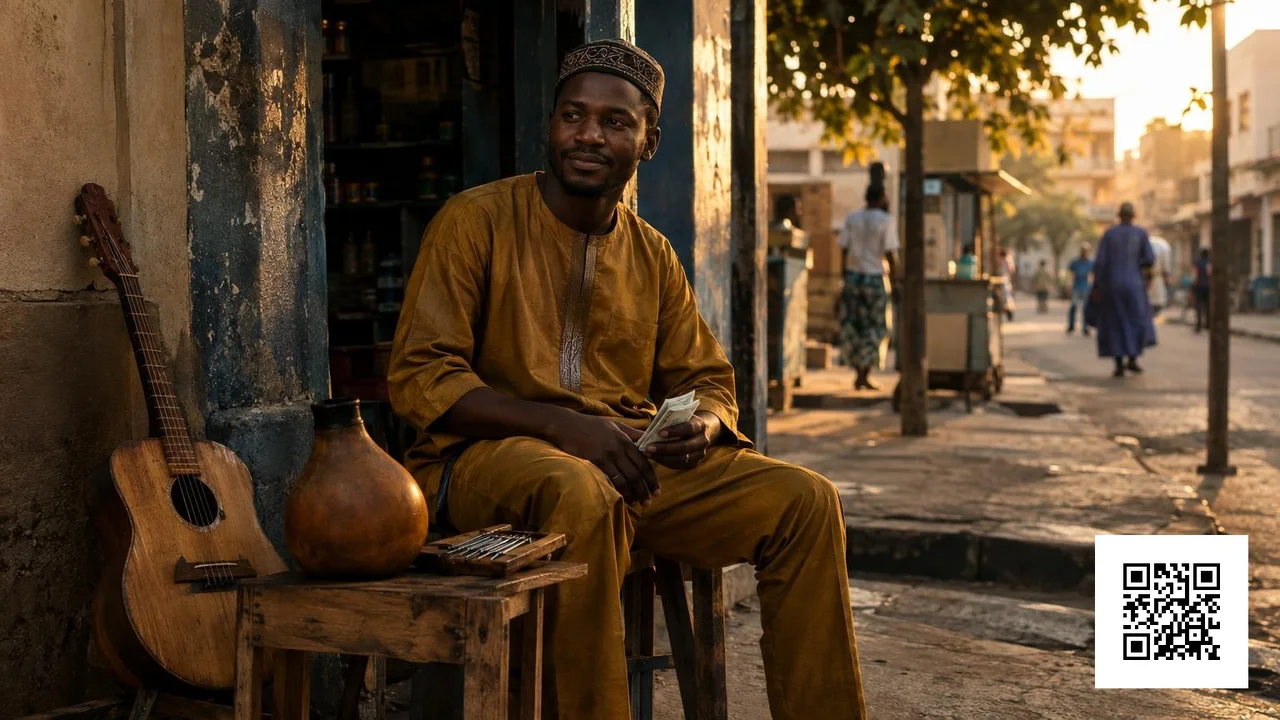
Argent au port opens in Senegal on a steady 90 BPM stride and a voice that speaks in Français. KEMAARU narrates small trades, money sent home and the practical movements that keep a household together, delivered in a warm baritone.
The arrangement leaves space. Palm-wine guitar sits at the centre, joined by soft calabash touches and light sanza phrases; the result is an intimate, breathable frame where each image, a folded bill, a corner shop, a letter on a bicycle, registers plainly.
Senegal’s steady 90 BPM stride
The tempo is exact: 90 BPM fixes a walking pocket. That midtempo gives the song its physical shape. Lines arrive as steps and find rest within the beat, which keeps attention on daily movement rather than sudden gestures.
This pulse places the track inside West Africa’s acoustic singer traditions while keeping a measured urban step. The groove feels like a walk through neighbourhood streets in Senegal, where small transactions and exchanges mark time and relations.
French voice with Sahelian phrases
French is the song’s main public voice. KEMAARU uses Français to address listeners across the region, and short English lines and Sahelian local phrases punctuate the narration, folding registers into one thread.
That language mix names audience and place at once: it makes the song audible to Francophone listeners while holding onto local rhythms of speech. If you want to read about similar French-fronted palm-wine work, see Pas à pas.
Palm-wine guitar and a minimal frame
Palm-wine guitar is the accompaniment’s centrepiece. Guitar figures keep a steady pattern while calabash and sanza add small accents; the mix is deliberately spare so the narrative line never competes with dense arrangements.
KEMAARU’s warm baritone carries the story forward. The recording’s breathable space turns concrete images into musical facts rather than metaphors. For other tracks in this acoustic idiom, check All playlists.
Money, dignity and everyday scenes
Argent au port names remittances, receipts and small trades without sermonising. Sent money is presented as a responsibility and a promise, the practical ties that keep families together across distances.
The song speaks to working rhythms and domestic care: shopkeepers, riders, people who send and wait for parcels and letters. That social scale appears in the lyrics and the steady musical gait, a calm pride that registers in gesture and tone. For a wider Sahel perspective see Ténéré Voices, a Sahel hymn in Tamasheq.
Palm-Wine Guitar | West African Soul
Palm-Wine Guitar | West African Soul names a coastal and Sahelian acoustic style where a relaxed walking pocket supports storytelling in French and local phrases. In Senegal this strand often foregrounds solo voice and guitar with light, organic colour.
Where the style comes from
The style grows out of West Africa’s coastal singer traditions and itinerant storytellers who moved between towns and trade routes. Over time those practices folded into urban singer-songwriter approaches across Senegal and the Sahel, keeping an emphasis on narrative and everyday themes.
Defining traits
Key traits are a relaxed midtempo walking pocket, melodic palm-wine guitar figures, sparse accompaniment and a fronting vocal that often uses French alongside local phrases. Tempos around a steady midrange and a minimal arrangement let images and small gestures occupy the foreground.
For Argent au port those traits are explicit: 90 BPM, guitar at the centre, light calabash and sanza touches, and a warm baritone narrating scenes about money and care.
How this track fits
KEMAARU keeps the arrangement uncluttered so the narrative stays central. The choice to preserve space rather than add layers emphasises presence, slow motion and the practical detail of remittances. The track follows the style’s acoustic logic rather than moving toward electronic textures.
Neighbouring styles to explore
If this track interests you, try other West African acoustic threads on AFRIKANA such as French-fronted palm-wine songs and Franco-Sahelian singer-songwriter pieces. For playlists and related selections, visit All playlists or the Naija Heat playlist guide.