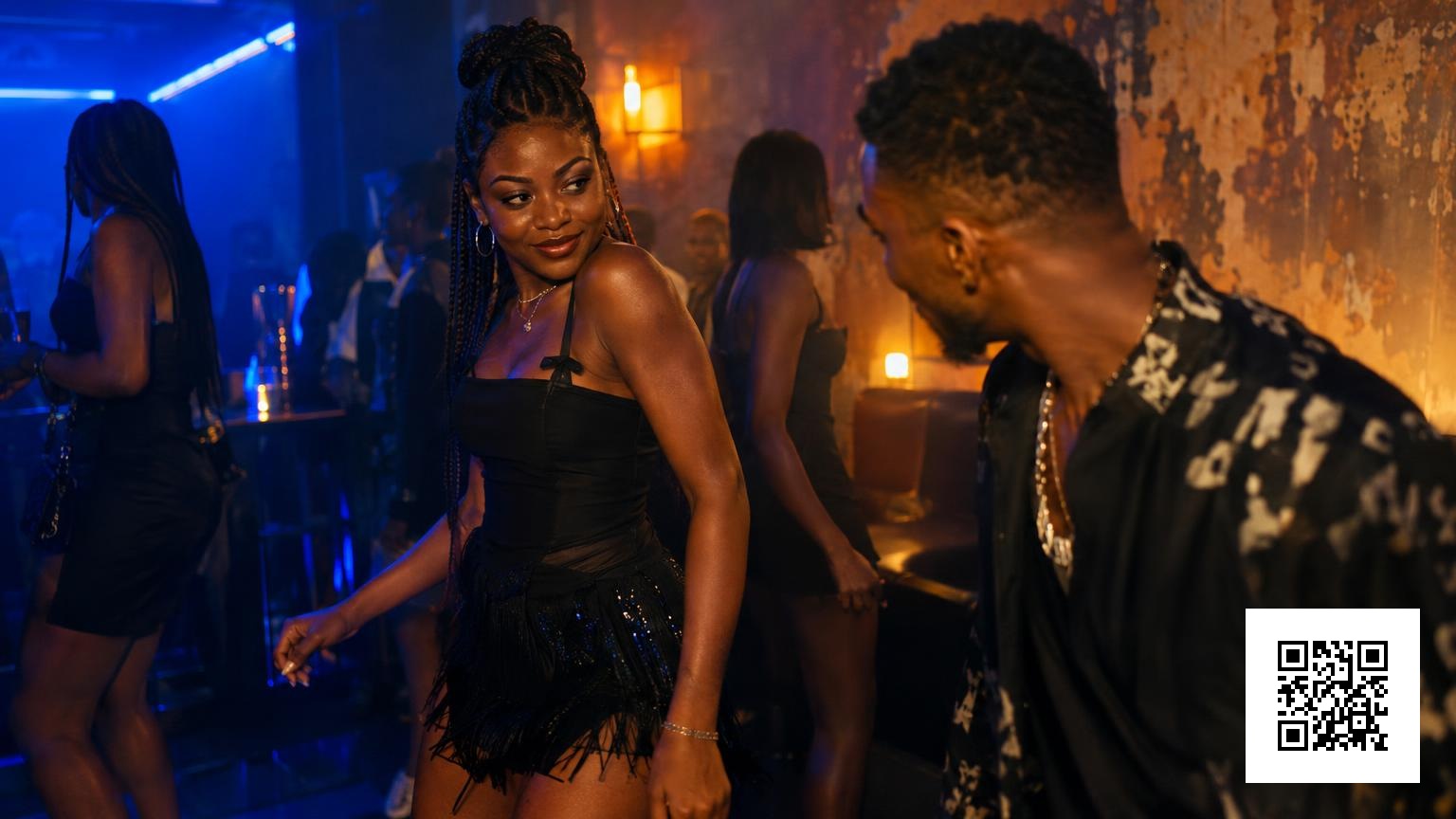
Ozali kotala runs at 125 BPM and speaks in Lingala, with a few words of Kinshasa French folded into the lines. The theme is simple and direct: Elle me regarde danser. That single sentence sits at the centre of how the song arranges who it addresses.
On first listen the choice of Lingala sets the address. Short, playful turns in that language carry the track’s teasing mood: sexy, youthful, loose, confident. The French moments act like quick city winks, specific to Kinshasa speech.
Lingala up front
Lingala is the primary voice here. The song puts extended Lingala turns where the public statements land. Those lines name the scene and the look: they are what the room hears when it decides how to move. That choice makes the record sound like a local announcement to Kinshasa speakers rather than a generalised club cut.
Because the track’s mood is teasing and addictive, Lingala does two jobs at once. It carries the flirtation and it signals who will catch the joke. Listeners fluent in Lingala recognise compressed turns, the easy commands and the shared winks that make a small crowd laugh and tighten its step. 30 New Lingala Love Stories ❤️ African Gu…
French kinois as a city wink
The few words of Kinshasa French are brief interventions. They do not translate the Lingala lines. Instead they punctuate them, like a raised eyebrow in a crowded bar. That urban French carries local indexicality: it says Kinshasa without spelling it out.
Those French turns also widen the audience slightly. A non Lingala speaker who knows Kinshasa street French will pick up the momentary public cues and feel included. The result is layered address: the track can be specific and metropolitan at once. See how neighbouring city textures appear in our coverage of urban sounds on Heart of Africa : tous les articles.
Who the song speaks to
Ozali kotala addresses a Kinshasa club room where youth meet and read each other across the floor. The linguistic layout selects that crowd. People who share Lingala idioms and recognise Kinshasa French winks will feel the directness of the lines. Others will experience the song as mood and motion without all the verbal cues.
That audience choice matches the track’s theme: attraction without pursuit. The vocal language says: she looks, he notices, but he does not run. The phrasing feels like a private code spoken in a public place, a way of saying Le goût de ça (the taste of that) aloud and letting it work on people nearby. For playlists and similar tracks, check Toutes les playlists.
Language and the body in motion
Words here are mapped onto movement. The song names looking and dancing in Lingala; that language shapes the timing of phrases and the ways attention is shared on the dancefloor. Short vocal turns leave space for the body; the language choices become cues for when to step closer or step back.
Because the production is minimal and club-oriented, language becomes a form of choreography. The few French notes act as punctuation, the Lingala lines as the narrative beats. This is the Le goût de ça effect again, a phrase that signals a small, repeated pleasure that the crowd recognises. If you want a different linguistic layout, read our piece on vocal address in East African club music Ngoja nijaribu, Swahili chorus and Sheng léger city winks.
Kinshasa Neo-Afrohouse × Ndombolo Body Mechanics × Electronic Club Minimalism
This style name is how the song positions itself: a young Kinshasa take on Afrohouse that borrows ndombolo body language and pares production back toward club minimalism. It sits at the junction of local dance practice and a restrained electronic club approach.
Origins and development
The track uses ndombolo-inspired body mechanics as a structural idea rather than a stylistic pastiche. That connection appears in the vocal framing and in how phrases leave space for movement. Neo-Afrohouse here means Kinshasa flirtation grafted onto a club tempo and sparser textures.
Defining traits
Tempo is explicit: 125 BPM. Vocals are playful and mostly Lingala, interrupted by a few Kinshasa French words. Production is minimal and focused on dancefloor clarity rather than dense layering. The mood descriptors given are clear: sexy, teasing, youthful, loose, confident, addictive. Those words name the track’s intent and its rhythmic placement in a club set.
How this track fits or bends the style
Ozali kotala fits by foregrounding language as choreography and by keeping the electronic palette minimal. It bends the style by letting Lingala do heavy communicative work, so the song reads less like a universal club cut and more like a local proposition whose gestures travel outward through repetition and a steady 125 BPM pulse.
Where to explore next
If you want neighbouring styles, start with Afrohouse and Ndombolo-linked dance music. For broader playlists and related club forms, see our long plays and curated mixes on the app and site, and explore regional variations in other Heart of Africa pieces like Teléphone datugulen, Bamako phone-off anthem. Also try our collection of related moods on Afropop & Amapiano, African Music Radio….