Rhythm and how it moves the body
The track leans on a two-part propulsion: a buoyant, highlife-derived guitar pattern and tight, funk-influenced pocketed drums. The guitar lays down repeating, upward-moving figures that feel elastic underfoot; the drums sit slightly behind the beat to create forward momentum without urgency. Together they produce a walking pulse that invites both shoulder and footwork — the kind of groove that keeps people on the dancefloor and makes space for call-and-response interruptions.
That rhythmic placement matters: phrases in the vocals and brass are timed to land on the groove’s small openings, so moments of vocal answer or horn lift feel like release rather than interruption. Listeners move because the parts leave room for interaction.
Brass, guitar and the choir
Ascending brass moments
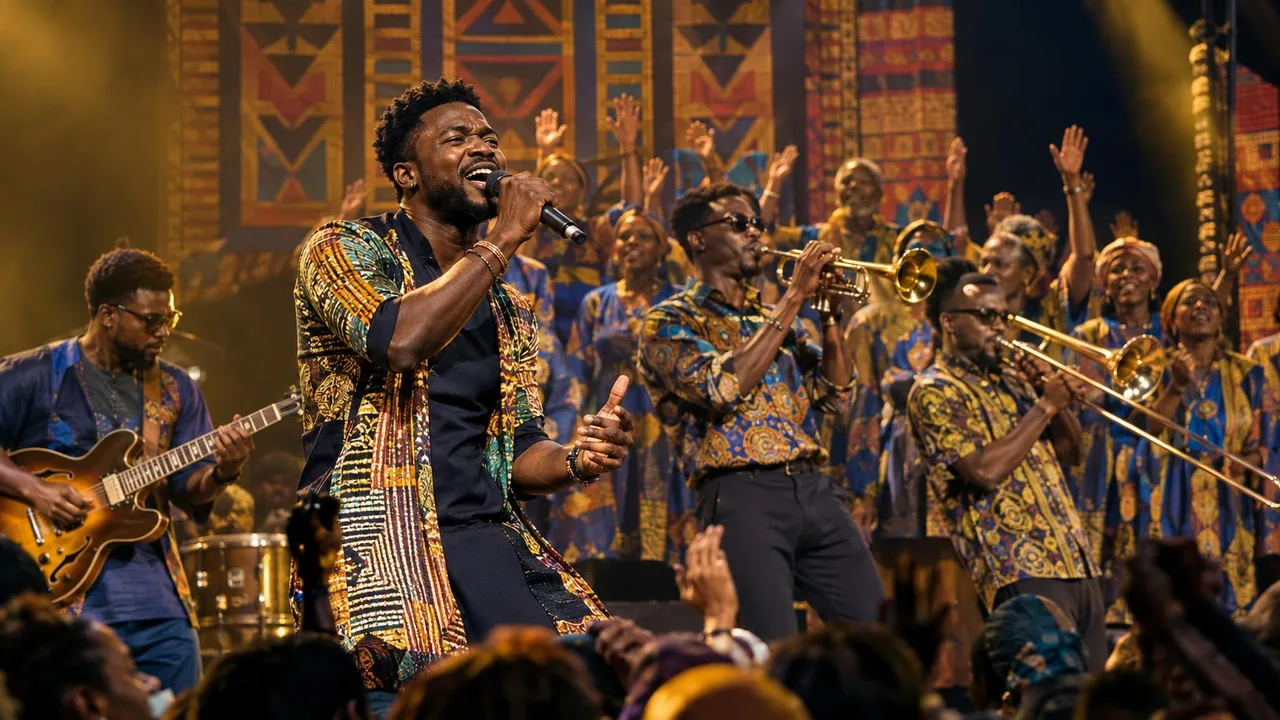
Brass in the arrangement functions as punctuation. Short, ascending lines lift the music into points of celebration and punctuate the choir’s responses. These brass hooks are arranged to cut through the mix and signal emotional peaks, often leaving air for the next human reply.
Highlife guitar and communal choir
The guitar takes a highlife pulse: cyclical, chiming, and rhythmically buoyant, it supplies harmonic motion without overwhelming the vocal space. The choir, by contrast, is the song’s social center. Not merely harmonic texture, the group voice carries slogans, refrains and communal replies that transform a performance into a collective act. Harmonies are kept bright and open to encourage call-and-sing participation in live settings.
Language: sounds and social work
This recording uses multilingual lyrics as structural tools. French verses frame narrative lines and stretch melodically across the harmony; an English refrain supplies a compact, repeatable hook; Fongbé responses operate as short, percussive cadences that lock with the groove. The alternation of languages creates contrast in timbre and phrasing: French lines often unfurl melodically, the English hook returns like a compact stamp, and Fongbé replies fold into the rhythm like an extra percussion layer.
Language here does social work as much as literary work. Call-and-response in Fongbé validates the lead voice and opens space for audience interjection, allowing meanings to be both communal and personal depending on who sings.
Region, tradition and public life
Songs like this are shaped by the public stages where they appear: markets, festivals and civic gatherings. In those contexts music is a forum for memory and aspiration — it commemorates, celebrates and proposes shared futures. Performance practices favor repetition and call-back so that large groups of people can join in, learn lines by ear, and carry them forward.
Participation teaches younger singers the phrasing and linguistic rhythms of their community; dance steps and communal response embed the music in daily social life.
Energy and who it is for
The energy is both celebratory and mobilizing. Brass lifts and a steady groove create moments of collective triumph; the choir’s call-and-response structure turns listening into doing. The music calls to market crowds as much as festival audiences, to people who want to sing together and to those who want sound that asserts local pride while remaining accessible across languages.
To experience it, focus first on the groove and the brass motifs, then follow the French verses for narrative content, the English refrain for the rallying anchor, and the Fongbé replies for communal interplay. The track is built to be shared.
Afro-Funk Béninois
Afro-Funk sits at the meeting point of West African popular music and global funk, where rhythmic drive and communal singing carry social meaning. Benin We Rise shows how Afro-Funk in Benin functions as both a danceable soundtrack and a collective statement.
Origins and development
Afro‑Funk in Benin draws on West African highlife guitar patterns and the rhythmic insistence of funk brought into urban popular contexts. Brass sections and massed voice traditions were folded into dance bands and festival repertoires, producing songs built for public performance and group participation.
Defining musical traits
Typical tempi sit roughly between 95–120 bpm. Drums favor a pocketed, syncopated backbeat that locks with buoyant, highlife-style guitar patterns. Basslines are cyclical and melodic. Vocals center on call‑and‑response and a communal choir; instrumentation commonly includes ascending brass lines, electric guitar, drum kit, percussion and bass.
How this track fits
Benin We Rise follows the blueprint: ascending brass hooks lift key phrases, a highlife guitar pulse propels the groove and drums combine funk pocket with highlife momentum. A communal choir anchors the arrangement and call‑and‑response is multilingual—French verses, a repeating English refrain and percussive Fongbé responses that lock tightly to the groove.
Styles to explore next
Highlife
Afrobeat