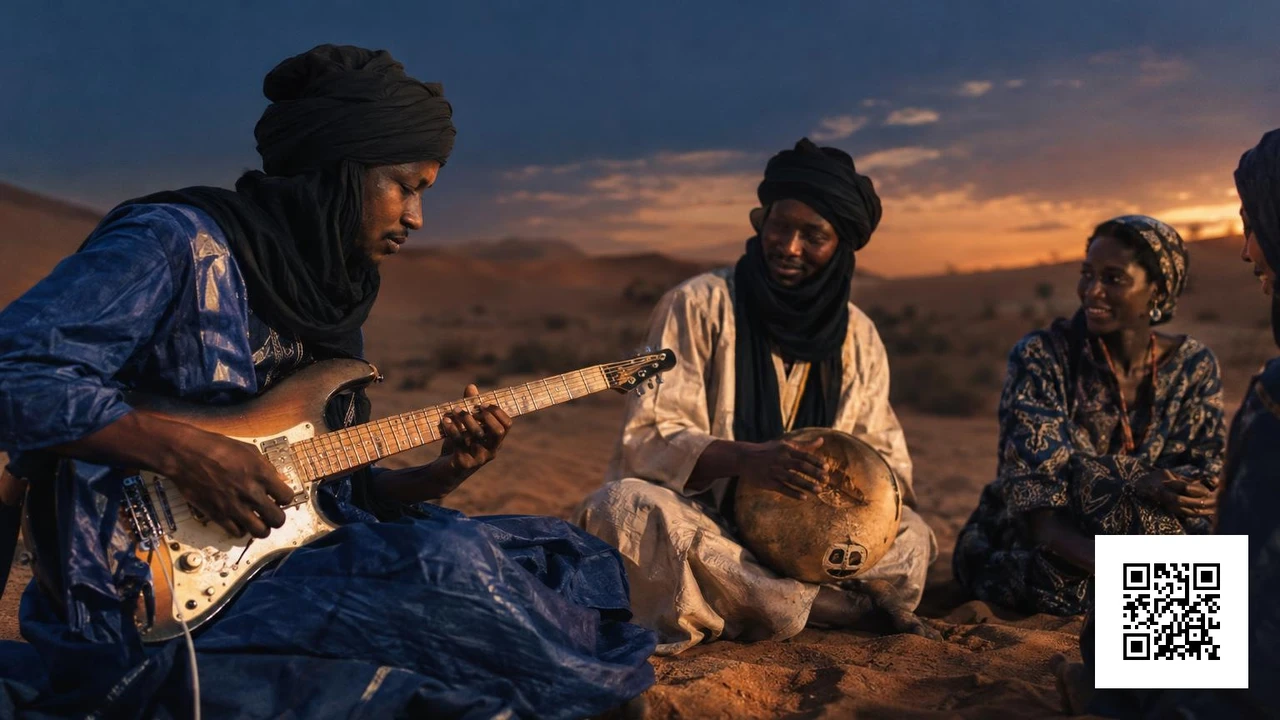
Azelik Rhythm opens with a locked tempo: 132 beats per minute. That number is audible immediately; it sets a forward, insistent pace that everything else measures itself against.
From the first loop you can hear the track’s intention. A pentatonic guitar figure repeats, a second string voice adds a kora-like shimmer, and sparse calabash and hand percussion mark the pulse. The song's description says it is a high-energy Desert Blues single combining pentatonic guitar riffs, kora-guitar textures and Saharan percussion.
Pulse and tempo
132 BPM gives the whole piece a dance-forward momentum. The beat stays steady rather than stretching the phrases wide; that steadiness makes small variations feel deliberate and urgent.
Because the tempo is fixed, timing becomes a language. A percussive strike arriving a little behind the click reads as a gentle delay; a string attack placed on the grid feels clipped and propulsive. These tiny shifts are how the arrangement sculpts motion without changing the underlying pulse.
If you want to compare a different Sahel approach, hear how Wind Over the Dune uses a slower horizon and a different breathing space in our archive Wind Over the Dune's 64 BPM Desert Pulse.
Strings and textures
The track’s spine is a pentatonic guitar riff: short, repeated motifs that the ear learns quickly. That motif is the anchor around which textures are added and subtracted.
A secondary string voice supplies a kora-inspired tone. It does not replace the guitar; it decorates the motif with ringing overtones and a harp-like shimmer that suggests traditional string instruments while staying in electric register.
Calabash and hand percussion give a tactile surface to the loops. They puncture rather than overwhelm the strings, so the melody remains clear while the rhythm acquires a grainy, bodily texture.
Voices and language
Lead singing happens in Tamasheq, delivered as short lines that invite immediate response. The vocal approach favours call-and-response; a lead phrase is posed and then met by ensemble refrains.
French refrains and phrases from Sahelian languages appear as punctuation points inside the looped structure. These moments alter syllabic shape and register, serving as chorus markers you can latch onto. Listen for the small tag Le goût de ça (the taste of that) as a local flourish that lands like an invitation to join.
The layout keeps the vocal phrases compact so the voice becomes another rhythmic element. It marks time and longing while leaving space for the string motifs to repeat.
Structure and communal motion
Azelik Rhythm builds by layering and removing elements over repeating cycles rather than by large harmonic shifts. The main loop repeats while textures change: a string line doubled, percussion pared back, a vocal answer added.
Those micro-changes create a sense of forward motion even though the core riff does not alter. The arrangement uses subtraction and addition to signal sections, which keeps the groove continuous and trance-ready.
This architecture supports collective movement and shared moments on the floor. For playlists that gather tracks with a similar celebratory energy, see our collection Celebratory and Uplifting African Music | Afrikana Best Sounds.
Desert Blues (Tishoumaren / Assouf)
Desert Blues here appears under the labels Tishoumaren and Assouf. It ties pentatonic repetition, plucked-string lineages and communal singing to desert life, and Azelik Rhythm presses those elements into a faster, club-ready pulse.
Where it comes from
Assouf springs from Tuareg and wider Sahelian musical practices in the Sahel and Sahara. Its roots lie in shared song forms and string playing that travelled with nomadic populations, and those echoes show in the short melodic cycles and call-and-response voice layout heard on this track.
Defining traits
Here the defining traits are explicit. The arrangement rests on pentatonic guitar riffs and a kora-like string tone, with calabash and hand percussion supplying Saharan textures. Vocals are lead Tamasheq lines answered by refrains, and the track’s 132 BPM tempo moves the style toward trance and sustained motion.
How this track bends
Azelik Rhythm stays loyal to Assouf through its melodic language and communal voice work while bending the tradition by choosing a brisk, electric tempo and a production clarity designed for the dancefloor. The kora-inspired guitar keeps an acoustic reference as the beat tightens the grooves.
Styles to explore next
If the combination of plucked strings and desert pulse appeals, try Kora Music and Manding strings for related timbres, or browse our playlists and radio sets for more Sahelian grooves on Toutes les playlists and across our pages at Heart of Africa : tous les articles. Also, take the music with you via L'application AFRIKANA.