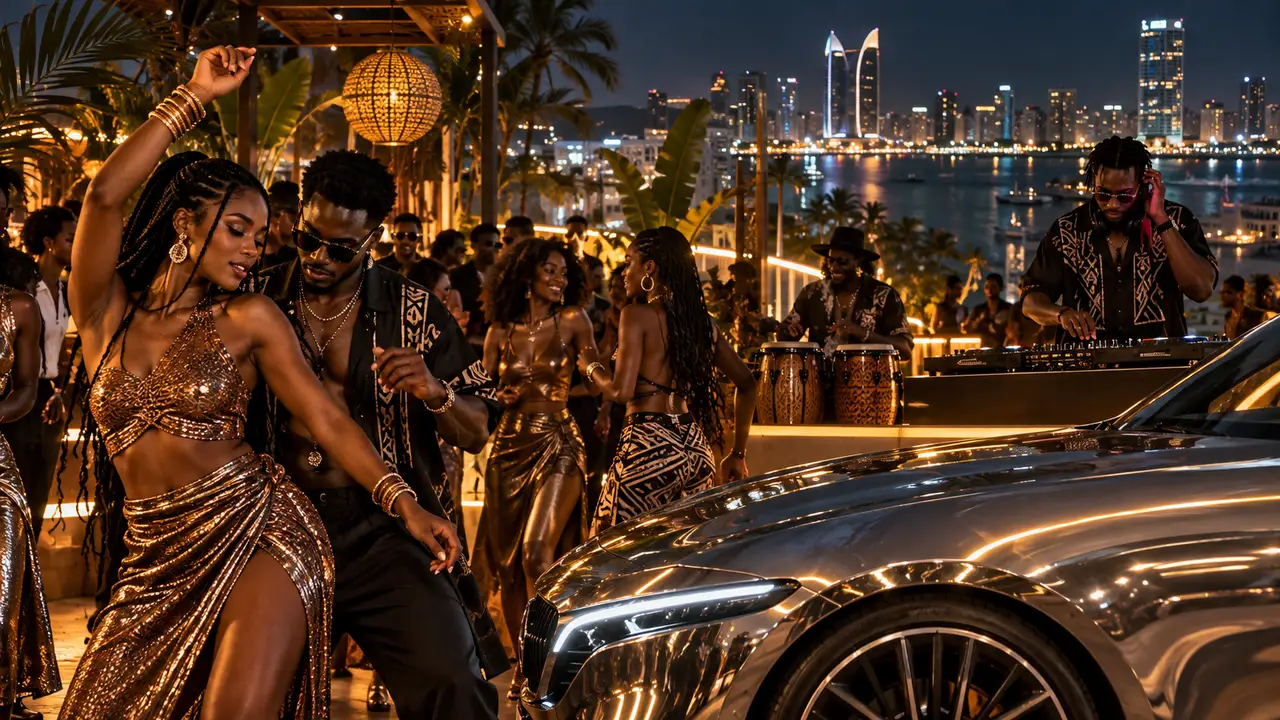
Rhythm: the night-drive pulse
From the first measures, the track locks into a steady four-on-the-floor pulse meant to propel the body forward. The kick is firm and rounded, a constant reference point while faster percussive figures ride on top. Those higher rhythms—shakers, conga-like patterns and clipped hand percussion—create a push-and-release that asks for small, continuous movement: shoulders, hips, a directed step. The arrangement gives space between hits so momentum feels intentional rather than frantic, the kind of tempo that maps well onto a highway glow or a slow club build.
Instruments: percussion and synth
Percussive layers
Percussion takes the foreground. Multiple rhythmic parts weave together: a deep, steady kick; midrange conga/shaker motifs that add swing; and occasional metallic or hand-played accents that cut through the mix. The result is tactile—skin-on-skin textures versus the hydraulic thump of bass—so the beat feels both human and engineered.
Electronic textures
Synth pads and arpeggiated lines sit above the percussion, polished and slightly glossy. They provide the track’s melodic contours: short motifs that repeat and evolve across sections, giving a sense of forward motion without overcrowding the groove. Low-end synths fill the car’s cabin or club’s subs, while brighter elements punctuate moments of lift.
Language: Swahili’s melodic role
Sung in Swahili, the vocals function more like an instrument than a narrative device in this context. Swahili’s open vowels and syllable-timed flow lend themselves to repeated hooks and chant-like lines; here, short, memorable phrases are framed to sit on top of the beat. Because the track thematically orients to sleek cars and nightlife, the vocal delivery emphasizes rhythm and cadence—punctuating the beat, accenting transitions, and adding human presence to an otherwise highly produced sonic palette.
Region: East African night tradition
Swahili anchors the song in East African lingual space and the urban night scenes where language, automobile culture and after-dark social life intersect. The track’s sonic choices—percussive layering married to club-ready production—reflect practices across contemporary East African dance floors: rhythmic complexity that still prioritizes a clear, driving pulse for collective movement. This is music that speaks to streets, to coastal towns and to metropolitan nightscapes where vehicles, lights and social rhythms meet.
Energy: who this track is for
“Usiku Wa Chrome” moves with a youthful, stylish energy aimed at listeners who want momentum—those seeking a night-drive companion, a late-set DJ tool, or a playlist slot that trades introspection for forward motion. It suits shared spaces: backseat head-nods, warm-up sets that need a sleek lift, or playlists built around modern, energetic club moods. The polished production and vocal hooks make it immediately accessible, while the layered percussion rewards repeat listens for details.
Afrohouse 2026
Afrohouse 2026 names a current branch of Afrohouse that foregrounds club-ready production within African electronic music. It situates the house pulse alongside layered percussion and vocal motifs drawn from African languages.
Origins and development
Afrohouse grew from global house roots combined with local African rhythmic sensibilities. Over recent decades producers across the continent grafted four-on-the-floor dance structures onto indigenous percussion patterns and melodic phrasing, creating a version of house that prioritises groove, space and language-specific hooks.
Defining rhythmic and sonic traits
Expect a steady four-on-the-floor pulse around 118–125 BPM, a propulsive kick with layered congas, shakers and percussive fills, and a warm, driving bass that anchors the mix. Synth textures are polished and often sparse enough to let rhythm breathe; vocals use short, repeated phrases or call-and-response lines in African languages. Arrangements favour dynamic builds and tight edits for club and night-drive settings.
How this track fits
This recording is catalogued as Afrohouse 2026 and sung in Swahili, themed on sleek cars and nightlife. It deploys polished beats, an uplifting melodic line and Swahili vocal phrasing that underline an energetic, youthful nocturnal mood—precisely the club-and-night-drive character signalled by the style tag.
Styles to explore next
Deep House; Afro Tech